
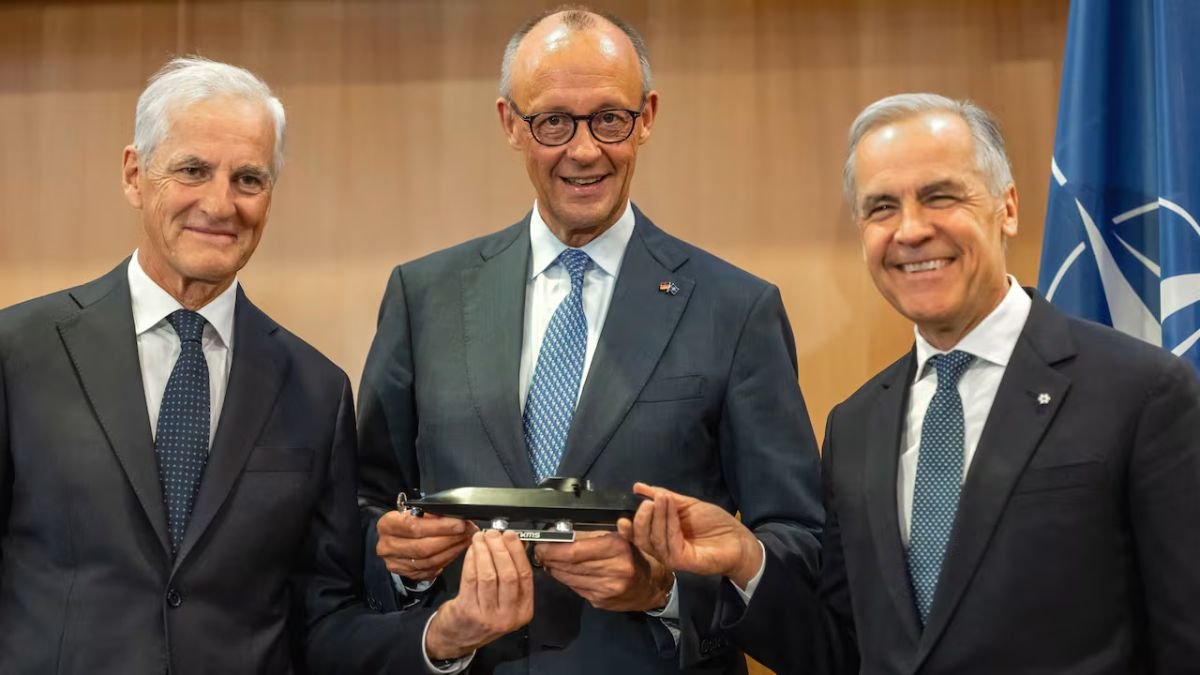
Prime Minister Mark Carney spent part of Tuesday at the NATO summit in Ankara balancing congratulations from the winning side and diplomacy with the disappointed runner-up after Canada selected a German shipyard to build 12 submarines for the navy.
Carney met with the leaders of Germany and Norway in a trilateral meeting after Canada accepted the bid from ThyssenKrupp Marine Systems, also known as TKMS. He also had a brief face-to-face exchange with South Korean President Lee Jae Myung, whose country’s bidder, Hanwha Ocean, lost out in the multibillion-dollar competition.
Canada Selects TKMS for Submarine Program
Carney announced the winning bidder less than 24 hours before the NATO meetings.
The decision means German shipbuilder TKMS, working with Norway, is now Canada’s preferred choice for the major submarine procurement program.
South Korea’s Hanwha Ocean finished as the runner-up supplier.
The decision marks a significant step in Canada’s effort to modernize its navy and strengthen defence capabilities within NATO.
Carney Meets South Korean President After Decision
Before arriving at the summit, Carney had informed President Lee Jae Myung of Canada’s decision by phone over the weekend.
Canadian officials had earlier suggested that Carney would hold a formal bilateral meeting with Lee during the summit.
However, that meeting was suddenly removed from the schedule.
The Prime Minister’s Office later said the two leaders had a more informal encounter on the sidelines of the gathering.
The brief meeting appeared to be aimed at easing diplomatic disappointment after South Korea lost the submarine contract.
South Korea Remains Important to NATO Partners
Lee attended the NATO summit because South Korea is becoming a major weapons supplier to many countries in the 32-member alliance.
Defence Minister David McGuinty said he understood South Korea’s disappointment but described Carney’s exchange with Lee as very positive and encouraging.
McGuinty emphasized that Canada’s relationship with South Korea remains strong.
He also noted that in any two-bidder competition, one company will win and the other will not.
Hanwha Ocean Could Still Be Considered
McGuinty repeated that if contract negotiations with TKMS do not succeed, Ottawa would turn to Hanwha Ocean.
He also said there are still many possible areas of cooperation between Canada and South Korea.
One of those areas could involve military equipment.
South Korea supplies armoured vehicles and mobile artillery to several of Canada’s close allies, and those are both types of equipment the Canadian Army is seeking.
Trilateral Meeting With Germany and Norway
Carney’s meeting with German Chancellor Friedrich Merz and Norwegian Prime Minister Jonas Gahr Støre had a more celebratory tone.
At the start of the meeting, Carney said Canada had made the right decision both for the country and for NATO.
The comments reflected Canada’s view that the submarine program is not only a national defence purchase but also a contribution to alliance security.
Germany Welcomes Canada’s Decision
Merz said Canada’s submarine decision was important for both Canada and Europe.
He described the agreement as more than a military procurement deal.
According to Merz, the decision could bring people and countries closer together and mark a new period of cooperation between Canada and Europe.
Earlier in the day, Merz told European media that the Canadian decision was also a major boost for the German economy.
Defence, Security and Resilience Bank Gains Support
At the same time, Canada announced progress on Carney’s proposal to create a Defence, Security and Resilience Bank.
Canada and eight other mostly small European countries said they would join the push to establish the institution.
The idea is similar to a World Bank-style model for defence.
It would allow countries to access private capital for critical security investments at lower cost.
Experts Warn Defence Spending Must Be Targeted
As more money flows into defence, some experts are warning that spending alone is not enough.
Rachel Ellehuus, director general of the U.K.-based Royal United Services Institute, said NATO countries must spend in the right way.
She said NATO has struggled with this issue in the past.
According to Ellehuus, alliance members need shared spending priorities that strengthen NATO as a whole rather than simply serving individual national interests.
NATO Needs Critical Capabilities
Ellehuus said defence money should focus on urgent capability gaps and critical enablers, not only long-term development programs.
She said many countries want to build advanced future weapons, such as next-generation fighter jets, but NATO also has immediate needs.
One of the most important gaps is drone production and deployment.
Many NATO countries also lack enough air defence equipment.
Canada’s Submarine Purchase Fills Strategic Gap
Canada’s submarine purchase will take several years to complete, but it is expected to help fill an important NATO capability gap.
The need has become more urgent because the United States has indicated it may no longer provide certain capabilities to NATO during a war.
Although the full list has not been published, reports suggest U.S. submarines are among the assets the Pentagon may withhold.
That makes Canada’s investment in new submarines strategically important for both national defence and alliance planning.
Mark Carney’s NATO summit meetings came immediately after Canada selected Germany’s TKMS, partnered with Norway, as the preferred bidder to build 12 submarines for the navy.
The decision was welcomed by Germany and Norway as a major step for Canada, Europe and NATO cooperation, while Carney also moved to manage relations with South Korea after Hanwha Ocean lost the bid.
Defence Minister David McGuinty stressed that Canada-South Korea ties remain strong and that Hanwha could still be considered if talks with TKMS fail.
Alongside the submarine decision, Canada also advanced its Defence, Security and Resilience Bank proposal, highlighting a broader push to strengthen NATO capabilities at a time when drones, air defence and submarine capacity are becoming increasingly critical.