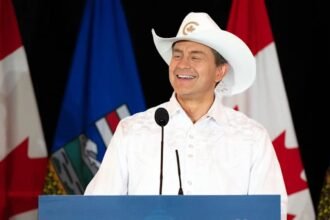
Prime Minister Mark Carney announced the new Canada-British Columbia Cooperative Prosperity Agreement with the Government of British Columbia on Thursday. The agreement is a broad economic, infrastructure, and investment strategy that includes major federal funding commitments for several projects considered important to B.C.’s future.
One of the most significant parts of the agreement is British Columbia’s commitment to work with the federal government and Alberta on discussions around Alberta’s proposal for a new crude oil pipeline to the B.C. coast. The project is intended to help Canadian oil reach overseas export markets and reduce the country’s heavy reliance on the United States.
B.C. Agrees to Discuss Pipeline Route and Permits
Under the agreement, Premier David Eby’s B.C. government has agreed to discuss routing and permitting for the proposed pipeline in “good faith.”
In return, Ottawa and B.C. will negotiate a legally binding economic and revenue framework based on the idea that British Columbia must meaningfully benefit from the project’s economic upside.
That framework would include giving B.C. a sizeable share of ongoing revenues from the pipeline.
Environmental Protections and North Coast Tanker Ban
The agreement also includes stronger proactive and reactive measures to deal with environmental impacts, especially potential oil spills.
A key condition for Premier Eby is that the federal North Coast tanker ban will remain in place.
Because of that tanker ban, the only realistic route options for the new pipeline would be toward southwestern British Columbia rather than the northern coast.
Carney Reaffirms Partnership With Alberta
Later the same day, Prime Minister Carney made a separate announcement confirming Ottawa’s continued partnership with the Alberta government to move the pipeline proposal forward.
At the same time, Alberta Premier Danielle Smith announced that after a year of early technical planning and analysis, Alberta had identified its preferred route.
The province said the strongest option is to follow the existing corridor between Alberta and B.C.’s Lower Mainland already used by the federally owned Trans Mountain Pipeline.
Trans Mountain and Pembina Join Pipeline Project
Premier Smith also announced that Trans Mountain Corporation and Pembina Pipeline have joined the project as partners.
Their role would involve designing, building, and operating the proposed pipeline.
So far, Alberta has spent C$18.3 million on planning and analysis for the new pipeline.
Smith said Canada has the resources needed to become an energy superpower, but only if it builds the infrastructure required to move those resources to global markets. She argued that Alberta has presented a responsible, world-class proposal and selected the strongest route to Canada’s West Coast.
According to Smith, the pipeline could create tens of thousands of jobs, generate tens of billions in new revenues for provincial and federal governments, and make Canada more secure and self-reliant.
Proposed Pipeline Starting Point in Alberta
The proposed pipeline would begin in Bruderheim, northeast of Edmonton.
At that site, a new receipt terminal would gather crude oil from several oil sands pipelines across Alberta. The terminal would act as a central hub where crude would be measured, stored, and then pumped into the new pipeline.
For much of its route, the pipeline would generally follow the existing Trans Mountain Pipeline corridor, especially between Wabamun, west of Edmonton, and Hope, at the eastern edge of B.C.’s Lower Mainland.
Alberta Says Route Would Use Existing Corridors Where Possible
Alberta’s project submission says the proposed route is designed to stay close to the existing Trans Mountain right-of-way wherever practical.
The province says this approach would use existing corridor knowledge, previous land-use data, and already developed access infrastructure.
The goal is to reduce the need for new untouched routes by making use of previously disturbed land and existing linear infrastructure wherever possible.
Two Route Options Through the Fraser Valley and Metro Vancouver
West of Hope, Alberta has identified two possible routes through the Lower Mainland to reach the proposed terminal at Roberts Bank in Delta.
Both options would generally run through the southern part of the region, but they differ in length and local impacts.
Original Corridor Route
The Original Corridor option would run west from Hope toward Bridal Falls, pass through Cultus Lake, and then continue parallel to the Canada-U.S. border through the Fraser Valley and Metro Vancouver.
This route would eventually reach the proposed Roberts Bank Delivery Tank Terminal.
From the Edmonton-area receipt terminal to the Roberts Bank terminal, the Original Corridor route would measure about 1,246 km.
Optimized Corridor Route
The alternative Optimized Corridor would take a partly northern path within the Lower Mainland.
From west of Hope, it would move toward Mission, then turn south through Langley before continuing to Roberts Bank.
This option would be slightly shorter, with a total length of about 1,211 km, making it roughly 35 km shorter than the Original Corridor.
Both routes have different advantages and tradeoffs, including how much they pass through protected agricultural land, recreational areas, and urban zones.
New Roberts Bank Export Terminal Planned for Tsawwassen
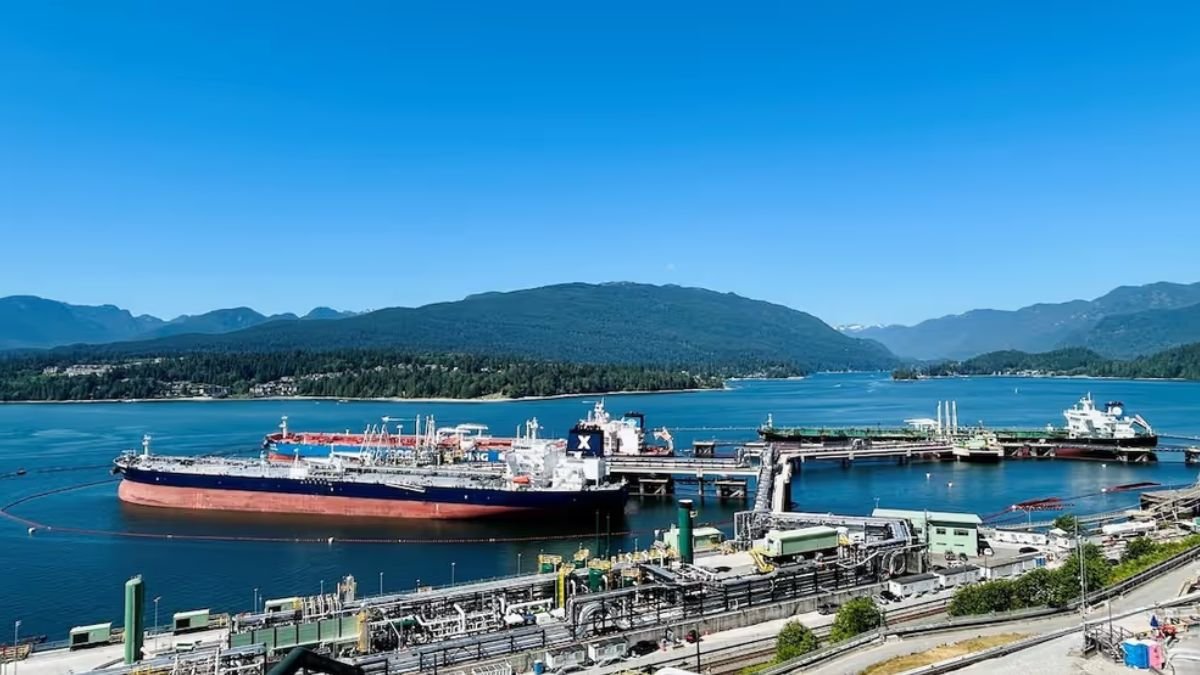
The proposed pipeline would not end at the existing Westridge Marine Terminal in Burnaby, which is already constrained by its location in Burrard Inlet.
Instead, the project would terminate at a brand-new, large-scale export terminal at Tsawwassen in Delta, in the Fraser River estuary.
The terminal would be built at the southwest corner of Metro Vancouver as a major new addition to the existing cluster of port facilities and infrastructure at Roberts Bank.
Five-Kilometre Causeway and Jetty Proposed
The new Roberts Bank terminal would not use the existing Roberts Bank causeway.
Instead, the project would require a new causeway and jetty reaching into the deeper waters of the Strait of Georgia.
The combined causeway and jetty would be about five km long, roughly similar in length to the area’s existing jetties used by the container terminal and BC Ferries’ Tsawwassen terminal.
Terminal Would Cover About 640 Acres
The full Roberts Bank terminal facility would cover about 640 acres.
It would include two offshore marine berths designed to handle Very Large Crude Carriers, or VLCCs.
Each VLCC could carry between 1.9 million and 2.2 million barrels of crude oil.
By comparison, the smaller Aframax tankers that currently serve the Westridge Marine Terminal carry about 750,000 barrels.
Oil Tank Farm and Supporting Infrastructure
About half of the new terminal site, roughly 320 acres, would be used for an oil tank farm.
The tank farm would include 15 tanks with total storage capacity of about 6.5 million barrels.
The facility would also include water retention ponds, a power substation, offices, warehouses, storage buildings, safety systems, and supporting infrastructure.
It would also include facilities for the Western Canada Marine Response Corporation.
Size Compared With Other Major Sites
For scale, Stanley Park in Vancouver is about 1,000 acres.
The existing Trans Mountain Burnaby Mountain tank farm covers about 190 acres, with 26 tanks capable of holding up to about 5.5 million barrels.
The current GCT Deltaport container terminal at Roberts Bank covers about 210 acres, not including the adjacent Westshore coal export terminal.
The planned Roberts Bank 2 container terminal would create about 450 acres of new land in the Strait of Georgia as a major extension of the existing port causeway.
Roberts Bank 2 Also Moving Ahead
The Vancouver Fraser Port Authority is expected to begin preliminary construction on Roberts Bank 2 in 2027.
The new container terminal is expected to begin operations in the mid-2030s.
As part of Thursday’s announcement, Prime Minister Carney committed significant but unspecified federal funding for the Roberts Bank 2 project.
This means two major port terminal projects at Roberts Bank could move forward on overlapping timelines.
Pipeline Capacity and Technical Details
The new pipeline would be designed to carry one million barrels of oil per day.
It would use a 42-inch-diameter pipe, larger than the 36-inch pipe used in the Trans Mountain expansion project completed in 2024.
The existing Trans Mountain Pipeline currently has capacity for about 890,000 barrels per day.
That system is intended to allow up to 34 oil tanker loadings per month at Westridge Marine Terminal, averaging about one or two tankers per day in Burrard Inlet.
Trans Mountain Capacity Could Also Increase
Under the Canada-B.C. Cooperative Prosperity Agreement, B.C. has also acknowledged Ottawa’s intention to increase the capacity of the existing Trans Mountain Pipeline.
The federal government wants to raise Trans Mountain’s capacity to 1.19 million barrels per day through measures that improve oil flow by reducing drag.
Estimated Cost Between C$35 Billion and C$44 Billion
The full Alberta-led project has a preliminary estimated cost of between C$35 billion and C$44 billion, including contingency.
That estimate covers both the new pipeline and the Roberts Bank Delivery Tank Terminal.
The project is expected to be funded through a mix of private-sector financing and certain forms of government support.
Construction Timeline
If the project proceeds as planned, preliminary construction could begin as early as fall 2027.
The project is being developed under a compressed timeline through the federal government’s new Major Projects Office, which is designed to prioritize projects of national significance.
Alberta is hoping the federal government will formally add the pipeline to the Project of National Interest list in October 2026.
Major construction would begin in September 2028, with full completion targeted for 2038.
Economic Impact During Construction
Construction spending for the pipeline and terminal is expected to range from about C$29 billion to C$38 billion.
This could increase B.C.’s real provincial GDP by almost 1.5 per cent at its peak in the early 2030s.
Nationally, the project and related activity could increase Canada’s real GDP by about 0.4 per cent at the peak of construction.
Job Creation Across Canada
The project is expected to support a large number of jobs, especially during the construction period.
At peak construction in the early 2030s, it could support up to about 140,000 jobs across Canada.
That includes about 45,000 jobs in Alberta and 70,000 jobs in B.C.
Roughly 15 per cent of total Canadian jobs linked to the project would be created in other provinces.
Total Spending Could Reach C$81 Billion
According to Alberta’s early estimates, construction spending for the pipeline, Roberts Bank export terminal, and related upstream activity could total between C$70 billion and C$81 billion from 2026 to 2038.
This includes not only direct pipeline and terminal construction but also associated activity linked to expanded oil production and exports.
Tsawwassen First Nation Context
Roberts Bank is located just west of the Tsawwassen First Nation reserve.
More than a decade ago, the First Nation briefly considered a proposal from its band leadership to build a liquefied natural gas facility on an 80-acre waterfront site northeast of the BC Ferries terminal.
That proposed LNG plant would have produced three million to five million tonnes of LNG per year, stored the fuel in three large tanks, and exported it through a new marine terminal at a Roberts Bank deep-water port.
It would have been supplied by a new 10-km pipeline connected to FortisBC’s natural gas system.
However, 53 per cent of the band’s members voted against the project, ending further consideration.
Reducing Canada’s Dependence on the U.S. Market
Alberta is presenting the new oil pipeline as a way to reduce Canada’s reliance on the United States as its main oil export market.
The province cites estimates suggesting Canada’s oil sector lost about US$49 billion between 2010 and 2025 because of wider price differences caused by pipeline congestion and limited export options.
In simple terms, Canadian crude has often sold at a discount because producers had fewer ways to reach markets beyond North America.
Access to Asian Energy Markets
The proposed pipeline is intended to give Canadian oil producers more direct access to international buyers, especially in Asia.
Alberta expects future customers to include buyers in China, South Korea, India, and Japan.
The province argues that energy demand and refinery capacity in these countries show strong long-term demand for Canadian crude.
U.S. Would Remain Important, but Risks Would Be Reduced
The United States would still remain Canada’s largest and most important oil export market.
However, Alberta argues that a new route to B.C.’s coast would reduce Canada’s vulnerability to market disruptions, trade disputes, policy changes, and political risks in the U.S.
The province also points to competition risks in the U.S. Gulf Coast market, including the possible return of Venezuelan heavy oil production, which could compete with Canadian crude for refinery demand.
Energy Security Concerns
Alberta also notes that past political resistance to cross-border energy infrastructure has raised energy security concerns.
One example is Michigan’s opposition to Enbridge Line 5, which has caused concern for energy supplies in Ontario and Quebec.
The Alberta government argues that Canada needs more export choices to limit exposure to future U.S. political changes.
Long-Term Economic Benefits
Alberta says the pipeline could become one of Canada’s largest nation-building economic projects.
The province argues that access to tidewater would help Alberta’s oil reserves reach fast-growing Asian markets, attract international investment, support high-paying jobs, and increase government revenues across Canada.
Beginning in the 2030s, higher oil production linked to the project could raise Canada’s real GDP by more than 0.6 per cent per year by the 2040s.
When broader household and business spending effects are included, the total economic boost could reach more than 0.7 per cent per year.
Major Impact on Alberta’s Economy
For Alberta specifically, increased oil production in the 2030s could raise real provincial GDP by more than 3.5 per cent on average by the 2040s.
The project could also narrow the price gap between Canadian heavy oil and the U.S. benchmark by up to US$3 per barrel by improving access to global markets.
At its peak, this could increase Canadian income by up to 0.2 per cent of GDP annually.
Local Government Tax Revenue
The project could also generate new property tax revenue for local governments.
Initial estimates suggest it could produce about C$68 million in property taxes, including about C$17 million in Alberta and C$51 million in B.C.
That amount is expected to grow substantially over the full life of the project.
Ongoing Jobs After Completion
Once the pipeline and Roberts Bank terminal are fully operating, ongoing oil production, maintenance, and trade activity could support about 50,000 jobs per year.
Supporters argue that these long-term jobs would add to the project’s broader economic value beyond the construction phase.